

I was telling a group of journalism students about the dead guy in the driveway photo, and they were all horrified.
How could our paper run a photo of a body? You can’t DO that, one of them said.
Why not?
It’s emotional, another answered.
It’s upsetting!
Yeah.
It sure is.
That was the whole point. Somebody came home one day, the crime-ridden town we covered, and found a body in front of his house.
Lying there. Like it was no big deal.
We thought it was a pretty damn big deal. Not the least for the dead fellow, left to rot like garbage.
So we treated it like a big deal, like we’d treated all the homicides that summer, like big deals worthy of front-page photos and great big headlines.
Like something worthy of being upset about. Like something worthy of emotion. Like something that needed to get shoved in people’s faces until somebody DID something to solve the crime wave and put murderers behind bars. LOOK AT IT. If you don’t like it, don’t tell me not to show it to you. MAKE IT NOT EXIST.
I thought of that conversation during this week’s Rolling Stone cover freakout:
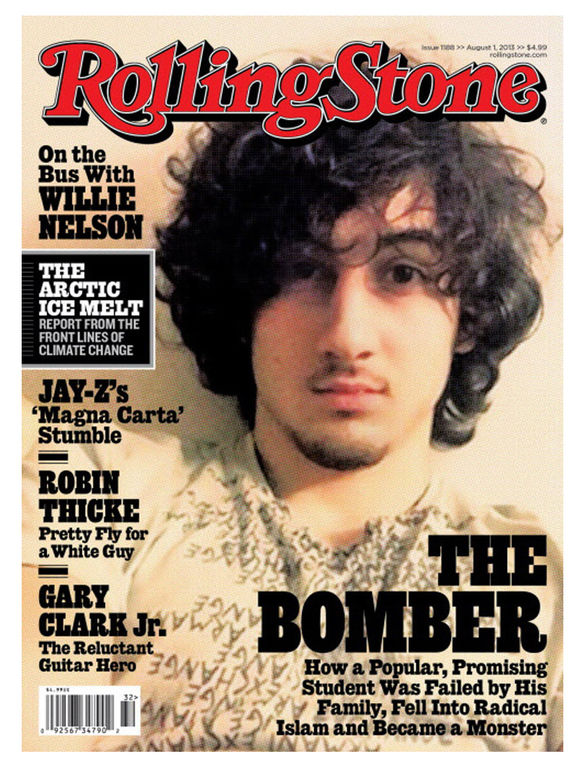
I thought of the flipout over the photos of the dead and wounded in Iraq a couple of years into that war, when conservatives screamed treason at photographers risking their lives to show Americans at home what they’d waved their flags and cheered for. I thought of the way we hid the coffins coming home, ostensibly out of respect for the dead, but mostly out of cowardice: Don’t make me look at what I’ve done. Don’t make me look at what I’ve allowed done in my name.
Journalism should be provocative. It should be upsetting. It should make you angry or outraged or scared. It should show you the world, in all its filth and glory, and if it doesn’t do that it is wasting your time. I don’t believe in shock value, by the way. If all you’re doing is showing off, seeing how many people you can offend, waving your e-penis around and asking people to look at how daring you are, you’re doing bad standup, not journalism. But ask yourself: Is that what this is?
Or is it making a point? Is it saying something? Is it a challenge to our sensibilities, to our ideas of what a terrorist is, to our assumptions that we can identify a danger on sight, and that such a person would never live next door to us, or go to our school? Why should that challenge be met with denial, and not searching, not thinking, not due consideration?
If you cannot look the world full in the face as it is, you can’t live in it, not really. And if you are unsettled by what you see, then you are obligated to change it, to work and push and grow and rage and speak until you are no longer ashamed when someone holds a mirror up to the place where you live and says this, this is what you are.
Journalism should push you, like every kind of art should push you. It should be profoundly disturbing to the status quo. At every turn it should take an agreed-upon assumption, a shrug of “that’s just how things are,” and yell in its face until the day-to-day is forced to take itself apart. It should ring in your head long after you put the magazine, the paper down and turn off the computer.
If not, if all it does is hide away the horror and sand off the rough edges of the world, tell you how to make the unthinkable palatable for yourself and your family, tell you how NOT to hear or think or speak or breathe the things that are true, it’s wasting your time.
A.