
Pulp Fiction Thursday: No Bones About It
That is one scary looking pitchfork. I wouldn’t want it near my head. Continue reading Pulp Fiction Thursday: No Bones About It

That is one scary looking pitchfork. I wouldn’t want it near my head. Continue reading Pulp Fiction Thursday: No Bones About It

What Michael Tisserand did during the lockdown. Continue reading Book Review: My Father When Young

One time, one night in America. Continue reading Not Everything Sucks: Viva Vindman


I was present at the creation of the Truman myth. It came in response to Watergate. The straightforward 33rd president was seen as an antidote to the slippery and crooked Richard Nixon.
The Truman myth began in earnest after the man’s death on the day after Christmas in 1972. The bible, as it were, of the myth was published the next year: Plain Speaking by Merle Miller. This oral biography grew out of a failed teevee project. The interview tapes had more or less sat in a closet for a decade before hitting the best seller list and staying there for months on end.
My mother liked to give me books for my birthday. Plain Speaking was my birthday book in 1973. It was enormously entertaining, so I devoured it. Even then I understood that Merle Miller’s Harry Truman was an embellished version of the real man.
I come from a long line of storytellers. My father’s business colleagues insisted that he was scrupulously honest. I believed them but I also knew he liked to embellish his stories to make them funnier and more interesting. I recognized the same traits in Merle Miller’s Harry Truman.
Plain Speaking Harry Truman was the hero of every story, especially in his dealings with enemies such as Gen. Douglas MacArthur. He was an erudite auto-didactic expert on world history and geography. He was loyal to a fault to the man who made his political career, Kansas City political boss and convicted felon, Tom Pendergast. Truman’s defensive refrain about Boss Pendergast was, “He never asked me to do a dishonest thing.”
It was hard not to be entertained by the sassy and feisty former president as he cussed out his enemies. His favorite word to describe Gen. MacArthur and others was counterfeit. Teenage me knew that nobody was *that* courageous in the face of their opponents. Merle Miller’s Harry Truman always sounded like the stuff we say to ourselves *after* an argument. You know, I shoulda said this that or the other.
The Truman myth went on the road with James Whitmore’s one-man show Give ‘Em Hell, Harry. I saw it and liked it. Like Plain Speaking it was enormously entertaining and provided the role of a lifetime for a journeyman actor such as Whitmore. The stories were embellished, but that’s entertainment.
The Truman myth was set in stone in 1992 by David McCullough’s Pulitzer prize-winning biography, Truman. McCullough is one of our finest non-fiction writers and he buffed and shined the Truman myth until it sparkled. He did comment on some of the less savory aspects of his subject’s political career, but they were outweighed by tales of the mythic Truman. What’s not to love about the story of the 1948 campaign? It’s when Truman became the patron saint of underdogs.
I know that there are many other Truman books, but Miller and McCullough are the mythmakers. One could even call the mythic Truman Miller-McCullough Man.
Now that I’ve taken some of the shine off the Truman myth, on balance I think he was a good president. He accomplished some major things such as the Marshall Plan and made a start on treating black folks as full citizens. He just wasn’t David McCullough or Merle Miller’s Harry Truman. He was a mere mortal.
That brings me to the reason for this post. Law professor and Lawyers, Guns, and Money blogger Paul Campos has published a bombshell piece in New York Magazine: The Truman Show.

Everything you know about the Alamo is wrong. Continue reading Book Review: Forget The Alamo


July has been wet, wet, wet in New Orleans. As long as it’s not flood-level precipitation I don’t mind it. It keeps the heat down. That’s summer in the Crescent City: too hot, hot, hot or too wet, wet, wet. My needle seems stuck, stuck, stuck…
Pete Townshend wrote this week’s theme song for the Who’s 1981 album Face Dances. It’s a criminally underrated record that I’ve loved since the first time I gave it a spin. It was the soundtrack of my life in the year I moved from San Francisco to Washington DC.
Don’t Let The Go was inspired by Townshend’s guru Meher Baba who urged his followers to “hang fast to the hem of my robe.”
We have three versions for your listening pleasure: the studio original, Townshend’s demo, and the Who live on German teevee.
Don’t let go the coat as we jump to the break.
Continue reading “Saturday Odds & Sods: Don’t Let Go The Coat”

I’m debuting a new featured image meme today. I’ve used the above image with the Fog of Scandal, but the ultimate scandal of the Trump Regime deserves its own meme. Books about the disastrous final year of the Impeached Insult … Continue reading Run Through The Milley

Don’t try this at home. Continue reading Pulp Fiction Thursday: We All Killed Grandma

Sinclair Lewis meets Donald Trump. Continue reading Ashli Babbittry

The house always wins. Continue reading Pulp Fiction Thursday: The Wheel Is Fixed
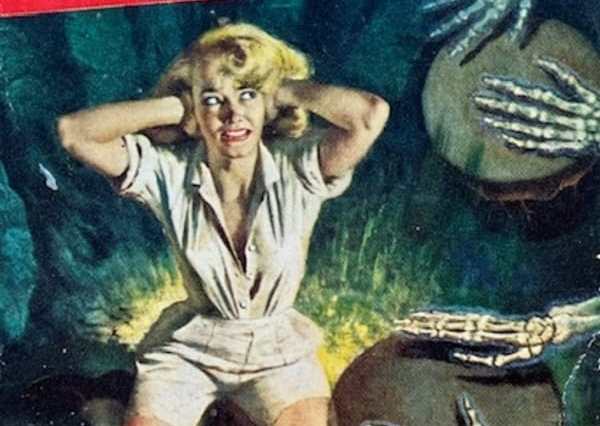
This is a highly regarded book that I haven’t read. I picked it because of the title and bony bongo fingers on the cover. Continue reading Pulp Fiction Thursday: Beat Not The Bones

Uh oh, it’s magic. Continue reading Pulp Fiction Thursday: Magic

Of Senator Sinema, Tucker Carlson, and Barstool Republicans. Continue reading Running Scared


It’s Juneteenth. It marks the day in 1865 that enslaved people in Galveston, Texas learned that they’d been freed two years earlier. It’s been a Texas holiday for decades and just became a federal holiday over the objection of 14 Republican congresscritters.
The featured image is a photograph by Dorothea Lange when she worked for the WPA documenting the ravages of the Great Depression. The number at the top is its Library of Congress reference number. I’m not quite sure that I get the title, but the picture was taken in Texas.
This week’s theme song was written in 1969 by Glenn Martin and Dave Kirby. I’ve always associated it with Doug Sahm, but it was first recorded by Charlie Pride.
We have three versions of Is Anybody Goin’ To San Antone for your listening pleasure: Charlie Pride, Doug Sahm, and the Texas Tornados.
Since I mentioned Galveston, let’s run this Glen Campbell-Jim Webb song up the flagpole and see who salutes:
Now that we’re done saluting, let’s jump to the break.
Continue reading “Saturday Odds & Sods: Is Anybody Goin’ To San Antone”

Victor Canning was an English writer who was more or less the poor man’s Graham Greene. A Delivery Of Furies is set during a rebellion in a Caribean country. Greene, of course, set several books in that part of the … Continue reading Pulp Fiction Thursday: A Delivery Of Furies


Every decade is the Me Decade for Naomi Wolf. Continue reading Tweet Of The Day: Naomi Wolf Edition


The featured image is a photograph by Diane Arbus who was an extremely interesting and deeply weird photographer. Her motto was: “Take pictures of what you fear.” Words to live by.
I’d amend that to say: Deal with what you fear. I’m trying to do that in my own life. I’ve long had a fear of heights and a bridge phobia, which has intensified as I’ve aged. The bridge phobia is particularly unfortunate as I’ve always lived in places where bridges are a fact of life. I just white-knuckle it and muddle through. What else can I do?
My phobias also explain why I’m taking it slow in regard to the COVID after times. I may be fully vaccinated but many are nor. It’s why I’m proceeding with caution. I did, however, eat in a restaurant on our anniversary. A small triumph for trying times. Oh well, what the hell.
Before moving on to our theme song, some Diane Arbus trivia. She was married to actor Allan Arbus who is best known as army shrink Sidney Freedman on MASH. Allan was also a close friend of Montgomery Clift. The late Patricia Bosworth wrote excellent biographies of both Monty Clift and Diane Arbus. If you like tragic tales of talented people who died too young, they should be up your alley.
Stephen Stills wrote this week’s theme song for CSNY’s 1970 album Deja Vu. As the opening track, it gets things off to a rousing start and remains a staple of his set lists. I’d say CSN’s set lists but Crosby’s malakatude has made a reunion impossible. Imagine pissing off the most mild-mannered of rock stars, Graham Nash.
We have two versions of Carry On for your listening pleasure: the studio original and a raucous live version featuring shouty, off-key vocals and sensational guitar playing by Stills and Young.
Ready to visit Disambiguation City? JJ Cale wrote and recorded *his* Carry On in 1981:
Now that we’ve had deja vu and worn shades, let’s jump to the break.

Looks like a regular dagger to me but what do I know about femme fatales? The only one in my life is a cat named for an actress who played them. Continue reading Pulp Fiction Thursday: Dagger Of Flesh

Another day, another firing squad reference. Continue reading Pulp Fiction Thursday: Memo To A Firing Squad

For some reason this cover gives me a headache. Continue reading Pulp Fiction Thursday: The Headless Lady
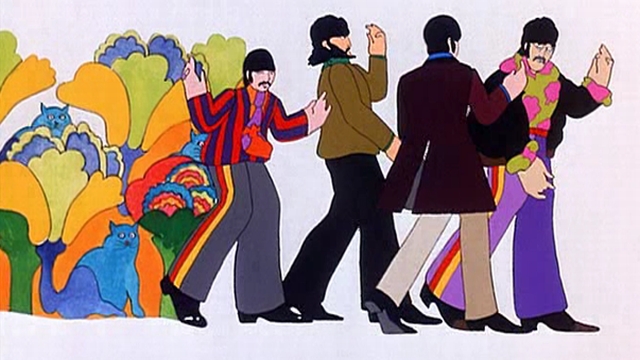

May is a month for themes at First Draft. Yesterday, I declared it Cole Porter month at the Friday Cocktail Hour. Today, I declare May to be Beatles month since Tell Me Why was last week’s theme song. I do declare. Stop me before I turn into Scarlet O’Hara. I’d look lousy in a hoop skirt…
President Biden visited New Orleans as part of his infrastructure push. He toured the Sewerage & Water Board plant in the Pigeon Town neighborhood. Our water system has been in bad shape forever. They’ve tried muddling through with what we have but what we need is money, money, money. The presidential visit is a good sign that it may be forthcoming. John Neely Kennedy insists that water plants aren’t infrastructure. I insist that he’s an asshole who can still go fuck himself.
This week’s theme song was written by Lennon and McCartney in 1965. Once again, it’s essentially a Lennon song. We’ll get to Macca next week. It was featured on three Beatles albums, Rubber Soul in the UK, Yesterday and Today in the US, and on the Yellow Submarine soundtrack worldwide. That was exhausting. Yeah, yeah, yeah.
We have three versions of Nowhere Man for your listening pleasure: the Beatles original, Randy Travis, and Paul Westerberg.
If you’re feeling stuck in Nowhere Land, there’s an easy fix: jump to the break.

It’s Cannibal Clown day here at First Draft. Continue reading Pulp Fiction Thursday: The Better To Eat You

From Twitter fame to Twitter infamy in the blink of an eye. Continue reading Malaka Of The Week: Twitter Famous Rob Anderson


Now that I’m fully vaccinated, things are slowly but surely getting back to normal at Adrastos World HQ. A close friend of mine paid an extended visit the other day. He’s an engineer so when he noticed that one of our front stairs was wonky, he insisted on fixing it. His motto is: “I fix shit.” Thanks, pally.
I’ve been listening to a lot of early Beatle. The music and lyrics may not be as sophisticated as their post-Revolver work, but the harmonies are to die for. They sang live in the studio back then and the blending of John and Paul’s voices is sublime. The best example of Beatly greatness I can think of is the fact that George Harrison was the third best singer in the band. And George was no slouch. Yeah, yeah, yeah.
There are many songs titled Tell Me Why. I picked three of them. The Beatles song is basically a John Lennon song and was written in 1964. The Beatles recording history is complex, the early US and UK albums were quite different. In the UK, it appeared on Hard Day’s Night and in the US on Something New. Yeah, yeah, yeah.
Our second theme song was written by Neil Young in 1970. It was the opening track on the album that made him a star as a solo artist, After The Gold Rush.
Our third theme song was also written in 1970. Barry Gibb wrote *his* Tell Me Why for the family band’s 2 Years On album.
Now that I’ve told you why, let’s jump to the break.

Evan Hunter DBA Ed McBain. Continue reading Pulp Fiction Thursday: The Con Man


We’ve had some unseasonably cool weather this week in New Orleans. It’s been a relief after last week’s constant rain. We’ve even had some sun, which was initially disorienting but I’m down with it.
It’s special election run-off day in the Louisiana-Second. An ugly and mendacious campaign was waged by the runner-up in the primary, State Senator Karen Carter Peterson. She wants a promotion after a disastrous tenure as state party chair and missing 85% of state senate votes last year. Talk about failing upward. I also happen to think that comparing another Democrat to Donald Trump is punching below the belt. I look forward to voting against her and for Troy Carter.
This week’s theme song was written in 1990 by Canadian singer-songwriter Shirley Elkhard and recorded by Bonnie Raitt for her 1991 album, Luck Of The Draw. It was a big hit for the Bonster. It was later used in the Julia Roberts-Dennis Quaid movie of the same title in 1995.
We have two versions of Something To Talk About for your listening pleasure: the Bonnie Raitt original and a 2016 version by Blood Sweat & Tears frontman David Clayton Thomas.
Was that bloody, sweaty, and teary enough for you lot? While we’re still wet, let’s jump to the break.
Continue reading “Saturday Odds & Sods: Something To Talk About”

The weather has been horrendous in New Orleans this week. We’ve had high winds, thunderstorms, and torrential rain. One day it looked as if we were having a tropical system out of season. I hate thunderstorms, they’re like heavy metal. I hate heavy metal.
It’s been so bad that we’ve had to work around the weather for fear of street flooding. Dr. A went to work preposterously early yesterday because she was administering an exam. I was so grateful that the garbage men closed the bin lid that I went on the porch and thanked them.
This week’s theme song was written by Francis Rossi for Status Quo’s 1968 album Picturesque Matchstickable Messages from the Status Quo. How’s that for a long ass title? It was to be the band’s only major hit single in the US&A.
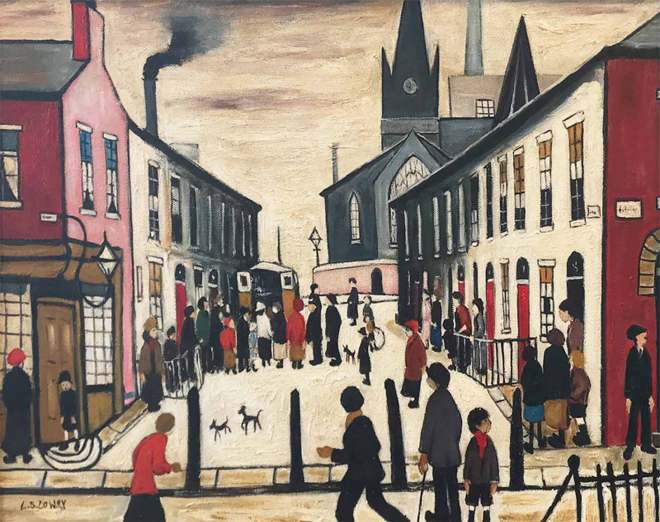
The song was inspired by the paintings of Mancunian artist LS Lowry. He pretended to be an unsophisticated artist but had serious chops as a painter. Lowry also excelled at myth creation often telling wildly contradictory stories. His painting Main Press is this week’s featured image.
There’s some dispute as to whether Lowry should be called a Mancunian artist since he lived in nearby Salford. But I like saying Mancunian so I’m sticking with it. FYI, a Mancunian is someone who hails from Manchester, England, mate. Who the hell wants to be a Salfordian or is that Salfordite?
We have three versions of Pictures Of Matchstick Men for your listening pleasure: the studio original, Status Quo live, and a 1989 cover by Camper Van Beethoven, which was a hit in the US&A.
We’re not finished with matchstick men, here’s a 2018 song written and recorded by Mark Knopfler:
Now that we’ve pondered matchstick men in music and art, let’s strike quickly and jump to the break.
Continue reading “Saturday Odds & Sods: Pictures Of Matchstick Men”

Boxing day comes early. Continue reading Pulp Fiction Thursday: Knock ‘Em Dead